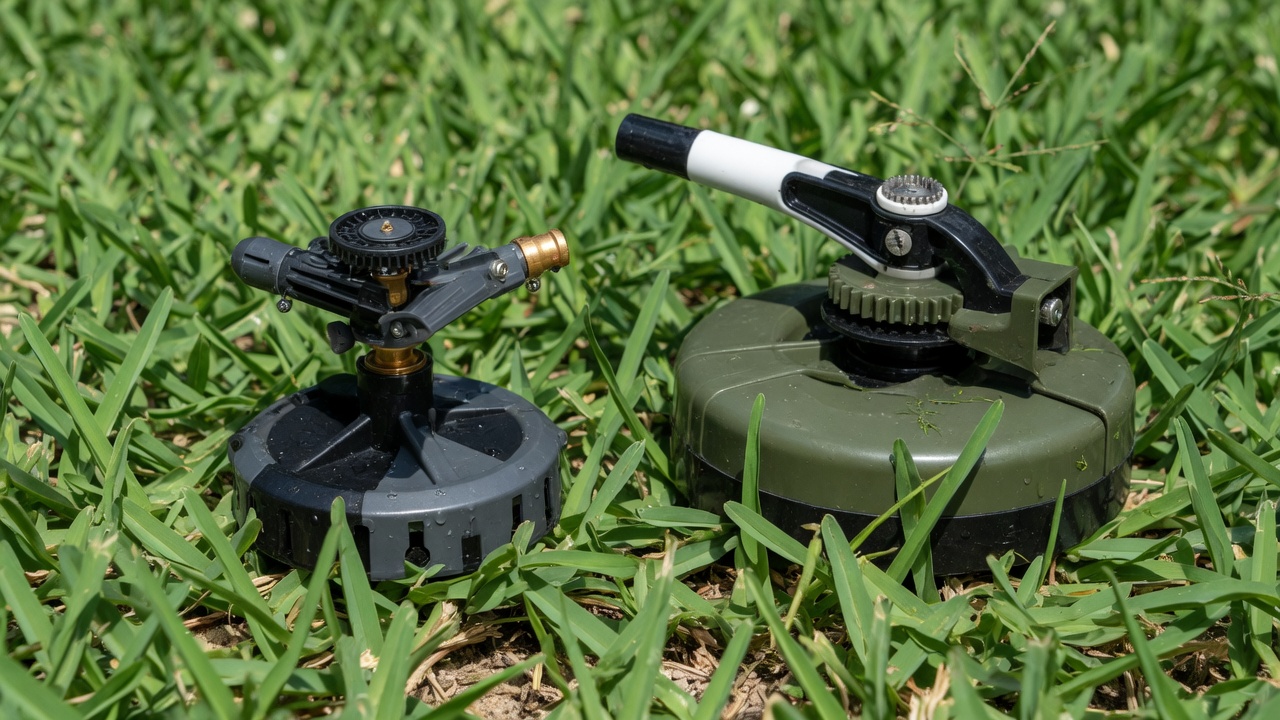
This is the question I get more than almost any other: which brand is better? The honest answer is that Hunter, Rain Bird, and Toro all make quality heads that will perform well in Houston — but they're not identical, and the differences matter depending on what problem you're solving and what's already in the ground.
I've installed and repaired all three brands hundreds of times across Houston since 2003. Here's my genuine take.
Rain Bird: The Default Standard
Rain Bird is the most widely installed brand in Houston, full stop. If you open a valve box on a system built in the last 20 years in this area, there's a 60% chance it's Rain Bird. That's partly because Rain Bird has been aggressively distributed through wholesale irrigation supply houses here for decades, and partly because it's genuinely a solid product.
The Rain Bird 5000 Series rotor is what I see most on residential properties in the Energy Corridor, Sugar Land, and the Woodlands. It's durable, the nozzle sizes cover most Houston lawn spacing scenarios well, and parts — including nozzles, ratchet assemblies, and screens — are available at almost every irrigation supply counter in town. That last point matters a lot to me: when I'm repairing a system at 7am, I need to be able to get parts fast.
The Rain Bird 1800 spray heads are equally ubiquitous. They work fine, hold nozzles well, and the body seals last a long time in Houston's soil conditions.
Hunter: Better Engineering in Some Areas
Hunter makes a few products that I genuinely prefer over Rain Bird for specific applications. The Hunter PGP Ultra rotor has a more robust check valve than most Rain Bird rotors at the same price point — it's better at holding residual water in sloped applications (less common in flat Houston, but relevant in The Woodlands and some parts of Katy with graded lots). The stall-prevention mechanism in the newer PGP series is also better designed than what Rain Bird has at the mid-range price.
Hunter's MP Rotator nozzles are the product I recommend most enthusiastically right now for Houston conditions. They rotate slowly and apply water at a very low precipitation rate — around 0.4 inches per hour compared to 1.5–2.0 inches for standard spray nozzles. That low application rate is a significant advantage on Houston clay, which absorbs water slowly and will runoff into the street if you apply it faster than the soil can take it.
If you have runoff problems — water sheeting off the lawn and into the street before the zone finishes — swapping standard spray nozzles for MP Rotators usually solves it without changing any pipe or heads.
Toro: Good Products, Harder to Source Parts
Toro makes quality heads and I have no complaints about their engineering. The Toro 570Z is a solid spray head and the Precision Series nozzles are well-designed. My one practical hesitation with Toro in Houston is parts availability — they're less commonly stocked at the supply houses I use, which means I'm more likely to be carrying replacement parts for Rain Bird and Hunter on the truck on any given day.
That's not a knock on the product. If you have Toro heads and they're working, there's no reason to replace them. Just know that repair parts may take a day or two to source locally.
Orbit and Store Brands: Avoid for Main Zones
I get asked about Orbit (sold at Home Depot) regularly. Orbit is fine for a single replacement head in a pinch, and their basic spray bodies work okay. But the nozzle quality is inconsistent, the check valves fail faster, and the body seals don't last as long in our climate. I wouldn't use Orbit for a new zone installation or a major repair — the cost savings aren't worth the shorter service life.
My Honest Recommendation
For rotors: Rain Bird 5000 Series or Hunter PGP Ultra, depending on lot slope. For spray heads: Hunter or Rain Bird 1800, with MP Rotator nozzles if you have runoff issues. For zones near pavement or sidewalks: check valve heads regardless of brand — these hold water in the head after the zone shuts off and reduce the puddle that forms at the head location.
The most important thing is usually not which brand you choose but that heads are properly spaced, nozzles are matched to your zone (all heads in a zone should have the same precipitation rate), and heads are set to proper grade. A properly installed Orbit head will outperform a misadjusted Rain Bird every time.
Not Sure What You Have?
We'll assess your existing heads during any service call and tell you whether replacement makes sense — without upselling you heads that don't need replacing.
(832) 786-4444