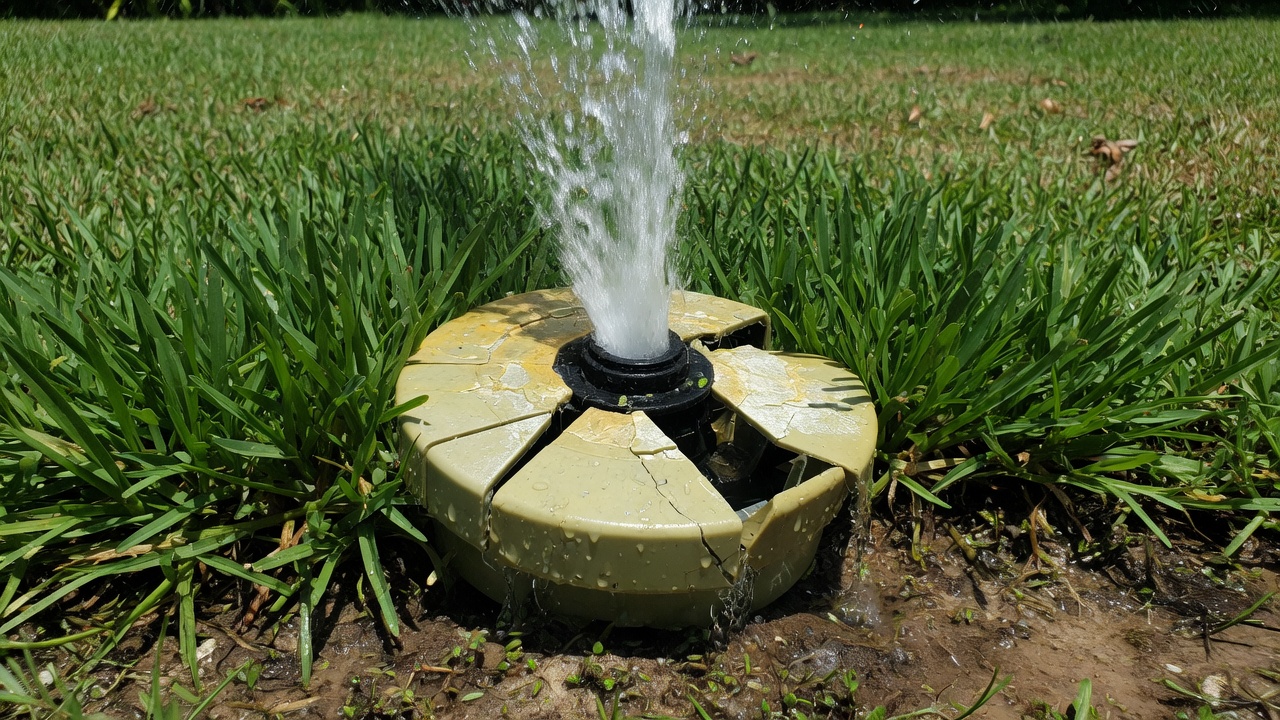
Sprinkler heads are the single most commonly damaged part of any Houston irrigation system. Between mower blades, car tires, the ruthless July sun beating on plastic, and St. Augustine runners that slowly choke out pop-ups, something is almost always about to fail. We repair and replace heads same-day in Houston and every surrounding city — and we carry the parts to get it done on the first visit.
Why Sprinkler Heads Fail in Houston
Every sprinkler head has a finite lifespan, and in Houston that lifespan is usually shorter than the manufacturer rating. The sun is the first killer — UV slowly embrittles the plastic case of a pop-up until the cap cracks, the riser seal fails, or the wiper seal on a rotor starts leaking when the zone is off. The second killer is mechanical damage, which in practice means a mower wheel, a pickup truck tire, or a landscaper's edger. On heads installed too close to driveways or curbs, it's not a question of if — it's a question of when.
The third killer is specifically a Houston thing. Our expansive Houston Black clay soil heaves seasonally. In wet winters the soil swells upward; in hot dry summers it shrinks and cracks. Over a few years, that movement tilts heads, buries the riser below grade, or sheers the swing joint underneath. The head may still work, but it's spraying into the grass blades instead of over them, producing all the visible symptoms of a broken head without looking obviously broken.
Finally, there's simple wear. The internal gear drive on a rotor eventually strips. The filter screen in a spray nozzle clogs with grit that worked its way past the backflow preventer during a pressure event. The nozzle itself — especially cheap generic replacements — wears oval and loses its pattern. These are all everyday repairs for us.
Signs You Need Sprinkler Head Repair
- A geyser shooting straight up instead of a normal fan or rotating stream
- A head that sprays sideways, over the fence, or onto the driveway
- A visible dry ring or dead patch in one part of a zone's coverage area
- Water dribbling out of a head for minutes after the zone finishes
- A cracked cap, missing nozzle, or head that's been mowed flat
- A pop-up that won't retract and is getting chewed by the mower
- A rotor that spins endlessly in one direction instead of reversing
Our Sprinkler Head Repair Process
We don't show up, eyeball the broken head, and slap on whatever we happened to throw in the truck. A proper head repair starts with a zone-level diagnosis because a single broken head often points to a bigger coverage or pressure problem.
- Run every zone: Before we touch any head, we turn on every zone and watch it operate. A broken head in zone 3 might be because zone 3 has lost a head entirely, dropping pressure and flooding the remaining heads.
- Identify the make, model, and nozzle: We match by brand and series — Rain Bird 1804, Hunter PGP-04, Toro T5 — so the replacement keeps the same arc, radius, and flow as the rest of the zone.
- Excavate carefully: We dig around the head with a hand trowel, not a shovel, to protect the riser and swing joint. On heads with fused threads we use a head puller to avoid cracking the lateral fitting.
- Install and align: We set the new head flush with grade, plumb vertical, and aligned to the intended coverage pattern. Cheap installers set heads high to make them "easier to find" — we don't, because that's how they get clipped.
- Adjust arc and radius: We dial in the arc to exactly what the turf shape calls for, adjust the radius for the actual spacing, and swap in a matched-precipitation nozzle if the zone needs it.
- Final test and cleanup: We run the zone from the controller, watch coverage under live pressure, and clean up the area. You shouldn't be able to tell we were there except for a working system.
What's Included
Every head repair call includes the following as standard — not add-ons, not upsells.
- Pop-up spray head replacement: We stock Rain Bird 1800 series and Hunter Pro-Spray bodies in 4", 6", and 12" risers for bed work.
- Rotor head replacement and adjustment: Hunter PGP and PGP-Ultra, Rain Bird 5000 series, Toro T5 and Toro Mini-8 rotors are all on the truck.
- Bubblers and drip emitters: For tree wells and flower beds we swap flood bubblers and pressure-compensating emitters.
- Nozzle cleaning and replacement: MP Rotator, variable-arc nozzles, and fixed-arc nozzles in the common radii — cleaned, swapped, or upgraded.
- Coverage arc and radius adjustment: Fine-tuning so every square foot gets water and nothing gets wasted on the sidewalk.
- Grade leveling: Re-seating heads that have sunk below turf level so the mower stops chewing them up.
Brands and Parts We Work With
Our trucks carry the full lineup of Rain Bird, Hunter, Toro, and Orbit residential and light-commercial heads. On a typical Houston residential system we're usually dealing with Rain Bird 1804 pop-ups paired with 15F/15H/15Q fixed-arc nozzles, or Hunter PGP-04 rotors with the blue #3.0 through red #6.0 nozzle set. For newer builds we see a lot of Hunter MP Rotators and Rain Bird R-VAN rotary nozzles, which we stock in every arc pattern.
On the higher-end custom-home installs around Memorial, West University, Tanglewood, and The Woodlands, we also service Irritrol, Weathermatic, and K-Rain products, plus the Hunter I-20 and Rain Bird 5004 commercial rotors. If you have an older Champion or Buckner head that's impossible to match, we can retrofit it with a modern body and swing joint that screws into the same fitting.
Head Issues Specific to Houston
Houston hits sprinkler heads harder than almost any market in the country, and a lot of that comes down to local conditions that out-of-town contractors don't account for. Our clay soil is the big one — as we mentioned, it heaves two to three inches vertically between wet and dry seasons, and heads that were installed level three years ago are now tilted, buried, or popped too high above grade. We use high-quality swing joints and funny pipe on every replacement so the head can move with the soil instead of fighting it.
The other major Houston factor is the February 2021 freeze and the smaller freezes that have followed it. Any head that had water trapped inside when it froze likely has a hairline crack in the body that leaks slowly when the zone runs. We see this constantly when the first hot weather hits in April and May — zones that held pressure all winter suddenly weep from multiple heads. Under Stage 1 and Stage 2 watering restrictions it's even more important to have tight, efficient heads — you only get two or three watering windows a week and you can't afford to waste them on leakers.
Pricing and How We Quote
Our pricing model is simple: we give you a firm, written quote before any work begins, so there are no surprises at the end of the job. Final pricing depends on how many heads need replacement, whether any are buried or require excavation, the brand and model of the head, and whether the swing joint or lateral fitting underneath also needs repair. We don't charge by the hour and we don't pad invoices. Every repair is backed by a written warranty on parts and labor.
Call us for a specific quote based on what you're seeing. If you can, snap a cell phone photo of the head and the broken part before you call — it helps us pre-stage the right parts on the truck and get you a more accurate quote over the phone.
Frequently Asked Questions
Can you replace just one head, or do I have to replace a whole zone?
Just one head is totally fine, and that's the majority of our head calls. If, however, we find that the zone has three or four sun-damaged heads on the brink of failure, we'll tell you — but there's no minimum, no trip fee surcharge, and no pressure to replace more than you actually need.
Can I mix brands — say, swap a Hunter into a zone full of Rain Birds?
Physically, yes — all the common brands use the same 1/2" female NPT inlet. But you shouldn't mix rotors and sprays on the same zone because their precipitation rates are dramatically different, and you should keep brand and series consistent on a zone so the throw and arc match. We always replace like-for-like unless you're doing a full zone rebuild.
Why does my pop-up head not retract all the way?
Usually one of three things: the wiper seal is worn and the retraction spring can't overcome the grit, the riser is bent from impact, or grass runners have wrapped the riser from underneath. First two we fix by swapping the head; the third we fix by clearing the runners and sometimes raising the head a notch.
Why is one head shooting a geyser?
The nozzle is missing. Either it was mowed off, a landscaper's trimmer knocked it loose, or the threads stripped and the nozzle popped out under pressure. Without the nozzle the head is essentially an open riser and throws a column of water straight up. Easy fix — we match the nozzle to the arc and radius the zone needs.
Should I upgrade from fixed sprays to MP Rotators?
In a lot of Houston yards, yes. MP Rotators apply water at roughly half the precipitation rate of fixed sprays, which means less runoff on clay soil and better infiltration. They also qualify for some water conservation rebates. We're happy to quote a full zone retrofit during any head service call.
Do I need to be home for the repair?
Not usually — as long as we can access the controller (garage or utility room is most common) and the yard. We'll call before we arrive, text you when we're on the way, and send photos of completed work if you're not there.
Got a Broken Sprinkler Head Right Now?
Tell us what you're seeing — we'll stage the right parts and usually have your zone running the same day.
(832) 786-4444