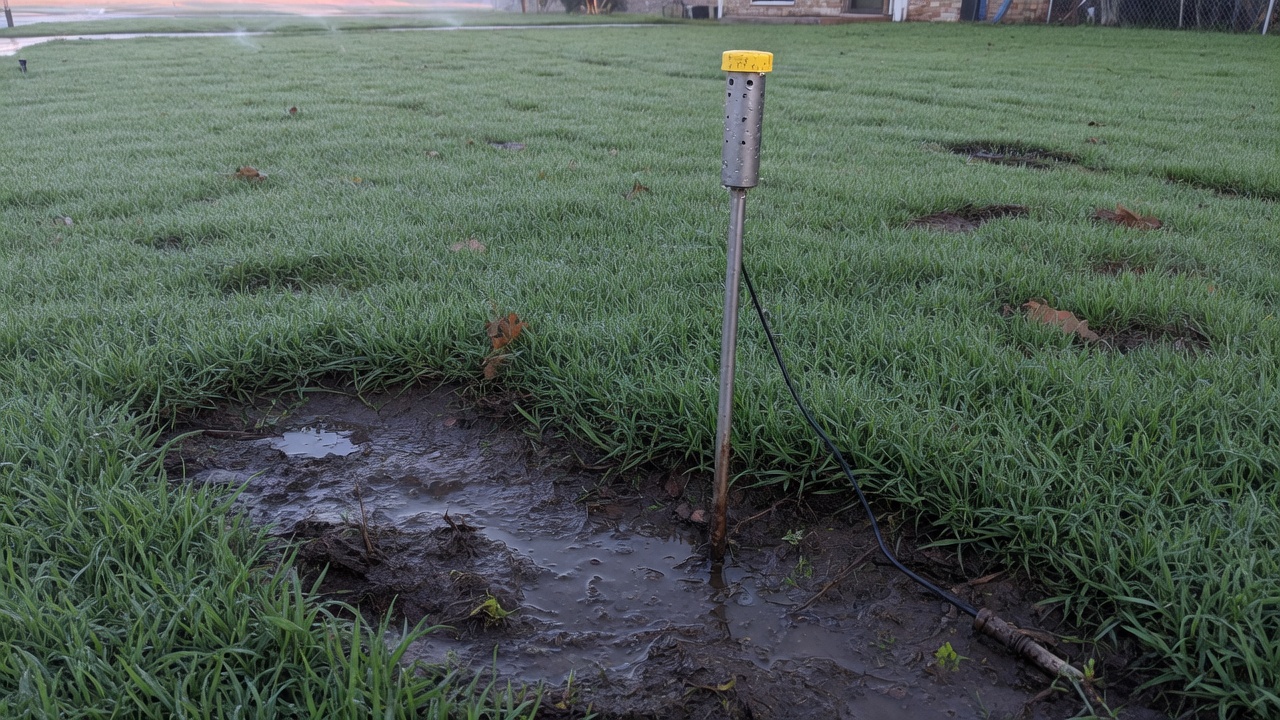
The scariest leak on a sprinkler system is the one you can't see. Underground mainline and lateral leaks waste water around the clock, spike your Houston Water bill by hundreds of dollars a month, and quietly wash the structural base out from under sidewalks and foundation slabs. We find them — with pressure gauges, acoustic probes, and a lot of Houston-specific pattern recognition — and we repair them without turning your yard into a trench network.
How Underground Leaks Hide in Houston Clay
In sandy or loamy soil, a leaking irrigation line usually announces itself. Water surfaces, grass greens up in a stripe, the ground gets spongy. In Houston Black clay, which is what most of Harris, Fort Bend, and Brazoria counties sits on, a leak can run for months without showing a single visible clue. The clay absorbs and holds water, swells instead of surfacing, and channels flow laterally through root mats and old tree roots until it pops up forty feet from the actual break.
That is why the "I walked the yard and I don't see anything" diagnosis almost never rules out a real leak. I have found mainline leaks that were running constantly at a quarter-gallon per minute, wasting somewhere around 10,000 gallons a month, with zero visible surface water and a lawn that looked perfectly normal. The homeowner only called because the water bill was suddenly unreasonable.
The slow, invisible kind is actually more common than the obvious kind around here, and it is the leak you want to catch early. Clay soils can channel water straight into an expansion joint and under a concrete slab, and that is how a cheap irrigation leak turns into a foundation repair estimate.
Signs You Have a Hidden Leak
- Water bill jumped noticeably month-over-month with no obvious change in habits
- A patch of grass is greener and taller than the rest of the yard — that's 24/7 feeding
- One zone has weak pressure, or heads on the end of a zone barely pop up
- Hissing sound near the backflow or anywhere along the property line
- Wet, soft, spongy ground that never fully dries even in dry weather
- Water in a valve box that doesn't drain after a zone finishes
- Mud or sediment spitting out of sprinkler heads on startup
- A sinkhole, depression, or ponding spot where there wasn't one before
- Your meter's low-flow indicator (the small triangle or gear) spins with every zone off
Our Pressure-Testing and Probe Process
We don't dig exploratory holes hoping to hit the leak. Our process isolates the problem to a single pipe run first, and only then do we open the ground — usually in a single keyhole-sized cut.
- Meter test first: With every zone off and every indoor fixture off, we watch your water meter's low-flow indicator. Any motion proves a live leak somewhere between the meter and the last sprinkler fitting.
- Isolate main vs. irrigation: We close the irrigation shutoff at the backflow and re-check the meter. If the leak stops, it's on the irrigation side; if it keeps running, it's on the house supply and that's a different repair.
- Zone-by-zone pressure drop: We cap the system at the backflow, pressurize the downstream side, and watch a gauge. A pipe run that won't hold static pressure has a leak on it — and we know which valve that run belongs to, which narrows the search to one zone's footprint.
- Acoustic listening: Over the suspect zone we use a ground microphone to pick up the characteristic rush of water forcing itself through a pinhole or cracked fitting. Houston's relatively shallow pipe depth helps the acoustic signature come through clearly.
- Probe and confirm: A thin steel probe tells us soil saturation without digging. When we find a clearly wet, soft zone at depth, that's almost always within a foot of the break.
- Keyhole excavation and repair: We cut a minimum-size hole, verify the break, repair with a proper Schedule 40 PVC coupling or slip-fix, pressure-test again, and backfill in layers so the turf heals cleanly.
Mainline vs Lateral Line Breaks
These are completely different leaks with completely different fixes, so the first question I'm answering on a detection call is which one we have. The mainline is the pipe under constant pressure from your backflow preventer to every zone valve — it is live water 24/7. A mainline leak runs continuously, whether the controller is on or off, and it is the expensive one to ignore. Mainline breaks typically happen at glued joints that failed from ground movement, at the backflow riser itself (freeze damage), or where a tree root wrapped and split the pipe.
Lateral lines are the pipes downstream of each zone valve that feed the heads. They are only pressurized when that zone runs — so a lateral leak only wastes water for 10 to 20 minutes when the zone happens to be on. A lateral break typically shows up as one zone running weaker than it should, a visible geyser somewhere in the middle of the zone, or a head at the far end that dribbles instead of spraying.
Both are fixable, but a mainline break needs to get fixed this week, not next month. Until we get there, we'll walk you through how to close the irrigation shutoff at the backflow so the leak at least stops running on your meter.
Meter Running With Everything Off?
That's a live mainline leak and it's burning money every hour. Call us, and we'll locate and repair it without tearing up the yard.
(832) 786-4444Why February 2021 Changed Everything
The Valentine's freeze that hit Houston in February 2021 broke an astonishing number of irrigation systems, and I'm still finding damage from that event four years later. Here's what happens. The backflow preventer, which sits above ground, froze solid. Water expanded inside the brass body and inside the mainline PVC, cracked somewhere, and then when temperatures warmed back up the cracks began to leak. Some systems started leaking that March. Others had only a hairline crack that didn't open up until the summer of 2022 or 2023, after the PVC had a few thermal cycles to finish failing.
If your system worked "fine" after the 2021 freeze but you've had a mystery high water bill any time in the last couple of years, I'd bet on a freeze-origin crack. The good news is we can usually narrow freeze cracks to a predictable handful of failure points — the backflow itself, the first 18 inches of pipe coming out of the backflow, exposed mainline at the house wall, and sometimes zone valves that had water trapped in their diaphragm bonnets.
What Happens After We Locate the Break
Locating a leak is one service call. Repairing it is a second piece of work, but usually the same visit. For a typical PVC mainline break on 1-inch Schedule 40, we cut out the damaged section, glue in a repair coupling with Schedule 40 fittings and PVC primer plus Oatey Rain-R-Shine cement, pressure-test the repair, and backfill. If we find a much worse problem underneath — say, a mainline with multiple old patches already on it, or a fitting that's obviously been compromised by root damage — we'll recommend replacing the run section rather than patching.
For lateral-line breaks at the head fitting, we often pull the head and swap in a new swing joint rather than gluing a repair, because swing joints take up the soil movement that caused the break in the first place. For leaks at a zone valve body or the valve itself, see our zone valve repair page.
Pricing and How We Quote
Leak detection is a skilled diagnostic job and we quote it separately from the repair because the repair cost depends entirely on what we find. You'll get a written price for the detection visit upfront. Once we've located the break and can see the failure, we give you a second written quote for the repair itself before we open the ground. No surprises, no "we found something worse, here's a bigger bill at the end."
Call us for a specific quote based on what you're seeing — how much your water bill jumped, whether the leak is obvious or invisible, and whether there's any sign of surface water or soft ground. The more you can tell us, the more accurate the phone quote.
Frequently Asked Questions
How do I know if the leak is on my sprinkler system or on the house supply?
Turn off the irrigation shutoff valve at your backflow preventer — it's usually a ball valve right at the backflow assembly. Check the meter again in 15 minutes. If the meter stops moving, the leak is on the irrigation side. If it keeps moving, it's on your main house supply and you'll want a plumber, not us.
Will you have to dig up my whole yard?
No. On 90 percent of our leak repairs we open one hole, smaller than a bath towel, right over the break. The whole point of proper detection is that we know where to dig before we start.
How long does detection and repair take?
Detection typically takes 45 minutes to two hours depending on system size and how elusive the leak is. A standard PVC mainline repair is another one to two hours after that, so most leak calls are same-day start to finish.
My leak is right at the backflow preventer — is that a different repair?
Yes. Backflow assemblies are their own specialty because they're regulated by Houston Water and TCEQ — the fix may involve a rebuild kit, a new check valve, or a full assembly swap. See our backflow testing and repair page for how we handle those.
Can high pressure cause leaks?
Absolutely, and it's the quiet killer in a lot of Houston subdivisions. If your static pressure is over 80 PSI — and plenty of Katy, Cypress, and Spring neighborhoods push 90 to 100 — the system is living above spec for PVC Schedule 40 and every joint is under constant stress. We can install a pressure regulator at the irrigation supply to add years of life to the whole system.
Should I be worried about foundation damage from a leak?
If the leak is within 10 feet of the house and running for weeks, yes — it's worth taking seriously. Houston clay soils swell differently when saturated, and uneven moisture under a slab is one of the main drivers of foundation movement here. Fix leaks fast and fix them properly.