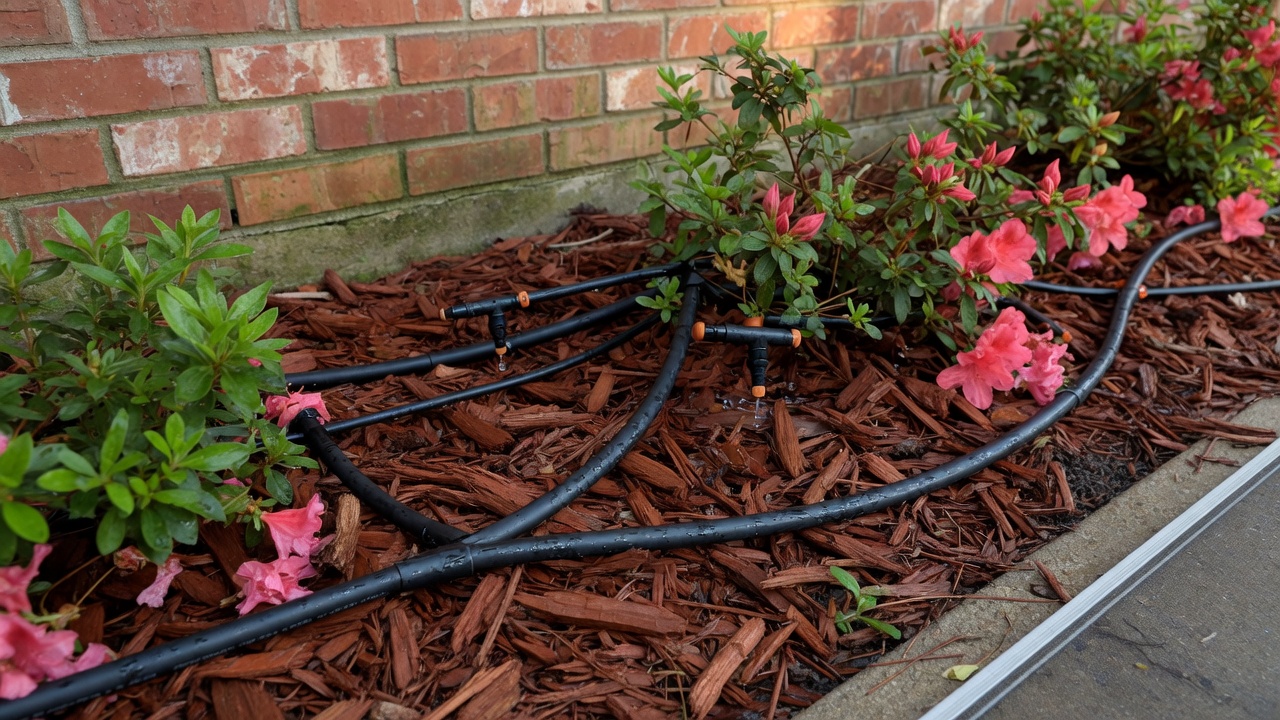
Drip irrigation is the single most efficient watering method available for Houston landscapes — and in the age of Stage 1 and Stage 2 watering restrictions, it's also the most flexible. Flower beds, trees, foundation plantings, vegetable gardens, and container gardens all do better on drip than on spray, and drip zones are usually exempt from the day-of-week rules that govern lawn zones. We install new drip systems, convert existing spray zones to drip, and repair the clogs, chewed tubing, and filter failures that make drip systems fail.
Why Drip Wins in Flower Beds, Trees, and Vegetable Gardens
A fixed-spray head throwing 1.5 inches of water per hour across a flower bed is a terrible match for the planting underneath. Half the water evaporates off the mulch surface, a big chunk runs off onto the sidewalk when Houston clay can't absorb it fast enough, and the water that does reach the plants hits the foliage — which in our humidity is a direct invitation to powdery mildew, black spot, and fungal leaf disease. Drip delivers water at the root zone, slowly enough that clay can absorb it, with zero foliage contact.
For trees, the math is even more lopsided. A mature live oak in Memorial needs roughly 10 gallons per inch of trunk diameter per watering, delivered slowly and wide of the trunk out at the drip line. A spray head at the base of the trunk wastes water on the lawn and does nothing for the tree. A properly designed drip ring or in-line emitter loop at the drip line is far cheaper to operate and dramatically better for the tree.
Vegetable gardens have a third consideration: food safety. Spraying overhead water on leafy greens and tomatoes in a humid Houston summer is asking for disease pressure and poor yields. Drip keeps the foliage dry and puts the water exactly where the root system wants it, which in beds with heavy amendments and compost can be six to twelve inches from the stem.
Stage 1 and Stage 2 Flexibility for Drip
Under Houston Water's drought stages, and most of the surrounding MUDs that follow similar rules, spray irrigation zones are restricted to specific days based on your address and banned between 10am and 6pm. Drip irrigation, soaker hoses, and hand watering are typically exempt from the day-of-week rule — you can run drip zones any day. That matters a lot in a dry summer when you have beds, annuals, or a vegetable garden that needs water more often than twice a week.
If you have a mixed system where beds are currently on spray heads, converting those bed zones to drip can give you back that flexibility. We've done conversions for clients specifically so their roses, citrus, and raised beds could keep getting water on the days their Bermuda couldn't.
Emitter Types and Flow Rates We Install
We work almost exclusively with pressure-compensating emitters, which deliver a consistent flow whether they're at the start of the run or the far end. Non-compensating emitters are cheaper at the garden store but deliver wildly uneven water in any run longer than about 30 feet, which defeats the whole point. The main types we install:
- Netafim Techline CV inline dripline: 0.6 GPH emitters at 12" spacing, built-in check valve. Our default for dense bed planting and foundation beds.
- Rain Bird XFCV inline dripline: Similar profile, check-valved, excellent for sloped beds where we don't want post-shutoff drainage.
- Point-source emitters on 1/4" spaghetti tubing: For container gardens, individual shrubs, and trees where we want a precise emitter count per plant. Typically 1, 2, or 4 GPH pressure-compensating buttons.
- Multi-outlet distribution heads: For row vegetable gardens where we're running four to six emitters off a single valve at the bed end.
- Tree rings: A loop of dripline at the tree's drip line, sized to the trunk diameter, usually 4 to 8 GPH total for young trees and more for mature canopies.
- Rain Bird Xeri-Bubblers: For trees and larger shrubs where a low-flow flood bubbler is a better match than pinpoint emitters.
Converting Spray Zones to Drip
This is one of our most requested retrofits in Houston. The existing zone valve and mainline stay in place, we cap the old spray heads, and we run dripline through the bed fed by the existing lateral. Critical components we add during conversion:
- Pressure regulator: Drip wants 25 to 30 PSI, not the 50-plus PSI your spray system is sized for. Without a regulator the dripline blows off the emitters.
- Filter: Even municipal Houston water carries enough grit over time to clog emitters. A 150- to 200-mesh filter at the zone valve is non-negotiable.
- Zone-specific controller adjustment: Drip runs far longer than spray — think 45 to 90 minutes per cycle instead of 10 to 20. We reprogram the controller so the drip zone doesn't get cheated on runtime.
- Flush valve or end cap with cleanout: So we can flush the dripline once or twice a year and keep it healthy for the long haul.
Beds Burning Up, or Drip Isn't Working?
We install new drip, convert spray zones to drip, and repair existing drip that's clogged, leaking, or chewed up. Call for a firm written quote.
(832) 786-4444Repairing Existing Drip — Clogs, Chewed Tubing, Filter Failure
Drip is fantastic when it works and unforgiving when it doesn't. Unlike a spray zone where a broken head is immediately obvious, a clogged emitter or a disconnected tube can run for months with the only symptom being a specific plant that's slowly dying while everything else thrives. Diagnosing drip problems requires patience and knowing the common failure modes:
- Clogged emitters from grit: The fix is replacing the filter at the zone valve, flushing the line, and in bad cases replacing the affected emitter buttons or dripline section. Always an upstream filter problem, never just the emitter.
- Clogged emitters from root intrusion: Drip lines buried in beds can have roots grow into emitter openings. Check-valve inline dripline (like XFCV) resists this much better than the cheap stuff.
- Chewed tubing: Squirrels, rabbits, and the occasional dog chew 1/4" tubing in particular. We switch to 1/2" mainline tubing where possible, or hide runs under mulch or small rock.
- Detached emitters: Over time the barb fittings where emitters press into the dripline can work loose, especially on systems without a pressure regulator. Fix is often "reseat them" the first time and "install a regulator" the second time.
- No water at all at the bed: Usually a bad solenoid on the zone valve or a controller problem, not the drip itself. See our zone valve repair page.
- Weeping after shutoff: No check valve upstream. We add a check-valve inline section or upgrade to CV-rated dripline.
Our Install Process
A proper drip install is fast, and the install itself is only half the work — design of the emitter layout and matching flow to the plantings is where the system lives or dies.
- Walk the beds: We map the plantings, note root-zone locations for trees and shrubs, identify sun exposure, and plan emitter density.
- Tie into the system: Either spin-off of an existing valve (conversion) or install a dedicated drip zone with its own valve, pressure regulator, and filter.
- Lay the mainline tubing: 1/2" poly mainline in long runs, hidden under mulch.
- Set emitters or dripline: Inline dripline at 12" spacing for dense beds, point-source for individual shrubs or trees, tree rings for canopy trees.
- Stake and cover: We stake the dripline at 2 to 4 foot intervals to keep it in place, then re-mulch so the system is invisible.
- Flush, pressure test, and program: Flush every run before capping, test at operating pressure, set the zone runtime on the controller, and label the valve.
Houston-Specific Considerations for Drip
Houston drip has a couple of quirks. First, our water is moderately hard, which over a few years can deposit calcium inside emitters. A biennial flush with a dilute CLR or manufacturer-approved cleaner keeps emitters clear — we include that on our annual service. Second, our clay soils hold water longer than sandy soils, so a drip schedule that works in Austin will overwater in Houston. We typically set drip zones to run less frequently but longer per cycle. Third, our mulch layers are often deep (3 to 4 inches of hardwood mulch is typical), and we run dripline on top of soil and under the mulch — never buried in clay, which invites root intrusion.
Pricing and How We Quote
Drip jobs are quoted based on bed square footage, number of zones, conversion complexity (if we're retrofitting existing spray zones), and the plantings. Every quote is written and firm before we start. For repairs on existing drip, we typically diagnose during the visit and give a per-line-item repair quote on the spot before any work proceeds. No surprise billing.
Call us for a specific quote based on how many beds, how much planted area, and whether it's new install, spray-to-drip conversion, or repair.
Frequently Asked Questions
How long should my drip zones run?
Typically 45 to 90 minutes per cycle on Houston clay, depending on emitter flow rate and soil slope. That sounds long compared to a spray zone, but drip applies water at roughly one-tenth the rate so the total water delivered is a fraction of what a spray zone would use. We'll set it based on your specific emitter flow and bed size.
Can I just convert my bed spray heads to shrub adapters and call it drip?
No, those are still spray nozzles and still restricted under Stage 1 day-of-week rules. True drip means inline dripline or point-source emitters below mulch level, with a pressure regulator and filter at the valve.
Will the drip tubing show?
Not after we re-mulch. All dripline gets staked down and hidden under 2 to 3 inches of mulch. On rock mulch we tuck it under the rock layer or use decomposed granite on top.
Do I need a separate zone for drip or can I share with my bed spray zone?
Separate zone. Drip operates at much lower pressure (25 to 30 PSI) and much longer runtime than spray — they can't share the same valve and schedule.
My drip system stopped working — is it expensive to fix?
Usually no. The most common fix is a clogged filter, which is a 15-minute repair. Chewed tubing is a splice-and-replace. Replacing a whole run of dripline is the biggest job and still much cheaper than a spray head overhaul.
Can drip be used for St. Augustine or Bermuda lawns?
Subsurface drip for turf exists (Netafim Techline HCVXR, for example) and works well, but it's a specialty install and more expensive than overhead spray. For most Houston lawns we recommend keeping turf on spray or rotors and reserving drip for beds and trees.