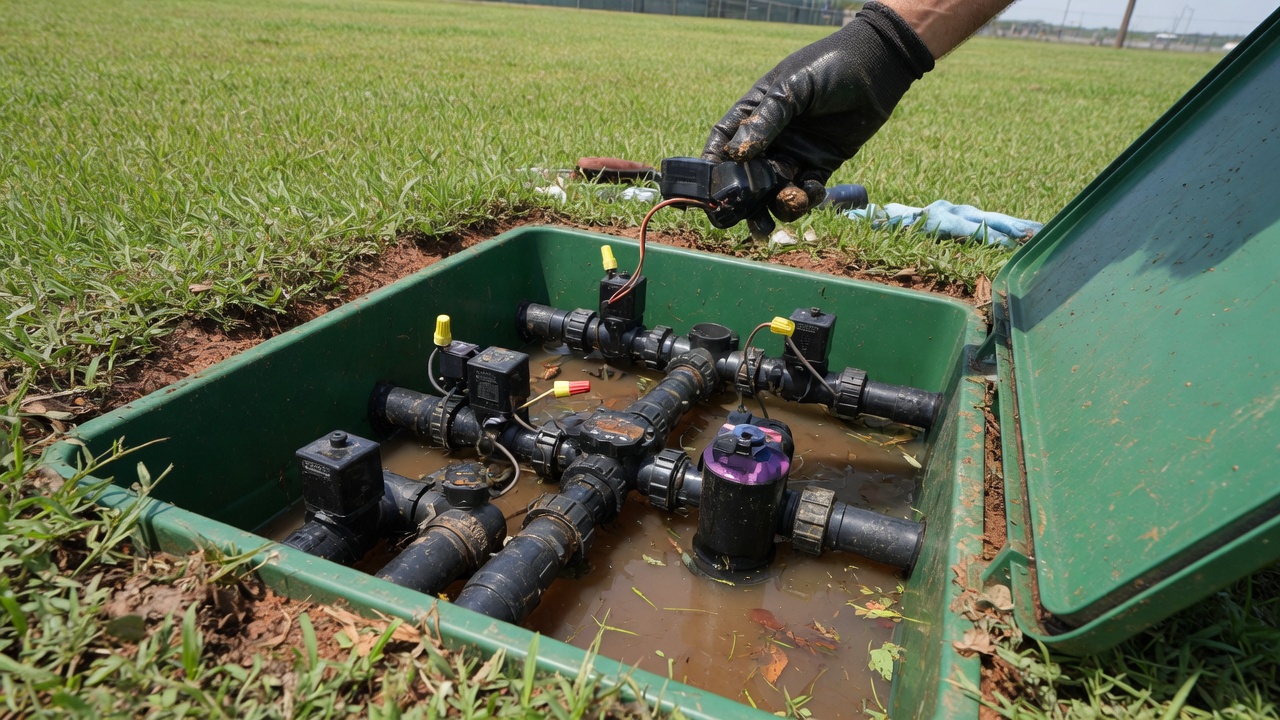
Zone valves are the unsung workhorses of every irrigation system. Each one opens and closes thousands of times a season, and when one fails the symptoms range from "that zone just stopped working" to "there's water running in my yard at 3am and it won't stop." Either way, we find the valve, diagnose the exact failure, and give you a firm price to rebuild or replace it before we start digging.
How Zone Valves Actually Work
Before we talk about fixing a zone valve, it helps to understand what one is. A sprinkler zone valve is a water-pressure-operated diaphragm valve with a small electric solenoid on top. When your controller sends 24VAC down the common and station wires, the solenoid lifts a tiny plunger inside the valve. That plunger vents the pressure from above the diaphragm, which lets the main water pressure push the diaphragm up, which lets water flow to that zone's sprinkler heads. When the controller cuts power, the plunger drops, the pressure equalizes, and the diaphragm snaps back down to close the valve.
This means a zone valve can fail in two very different ways. It can fail closed — meaning your controller sends power but water never reaches the heads, usually because the solenoid is dead, a wire is broken, or the diaphragm is stuck. Or it can fail open — meaning water keeps flowing even with power off, usually because debris is lodged under the diaphragm or the diaphragm itself is torn. Understanding which failure mode you're in tells us exactly where to look.
Houston adds some wrinkles specific to our conditions. Grit from aging mainlines, mineral scale from hard water, and corrosion from valve boxes that flood during hurricane season all accelerate valve failure. The February 2021 freeze also split a lot of valve bodies that had standing water inside them when temperatures crashed — those failures often only show up months later when the zone is first pressurized for summer.
Signs You Need Zone Valve Repair
- A single zone won't turn on even when the controller is clearly running it
- A zone turns on but won't shut off — you have to cut power to the controller
- Water is visibly weeping from one sprinkler head even when no zones are running
- You can hear valves clicking at the box but no water reaches the heads
- Pressure in one zone is dramatically lower than the others
- You smell mold or see standing water around a valve box
- Multiple zones are misbehaving (often wire or common-line issues, not the valves themselves)
Our Zone Valve Repair Process
Valve troubleshooting is a process of elimination. We follow the same diagnostic steps on every call so we don't miss anything — and so you get an accurate quote on the first visit.
- Controller and wire check: We verify the controller is actually putting 24VAC on the right station terminal. Dead controller stations are surprisingly common and get misdiagnosed as bad valves constantly.
- Solenoid resistance test: With the valve wired in, we measure solenoid resistance in ohms. A good solenoid reads around 20 to 60 ohms. Infinite resistance means open coil; near zero means a shorted coil. Both mean a new solenoid.
- Locate the valve box: Not every Houston home has clearly marked boxes. If needed we track the wire with a 521 series wire tracer or activate each valve manually at the controller to listen for the click.
- Manual bleed test: We open the bleed screw on the valve to confirm it's seeing mainline pressure and that the diaphragm responds. If bleeding opens the zone and electric activation doesn't, we're looking at a solenoid or wire issue.
- Rebuild or replace decision: Most valves can be rebuilt with a new solenoid plus a diaphragm/spring kit for a fraction of a full replacement. If the body is cracked, the manifold is corroded, or the threads are stripped, we quote the replacement honestly.
- Test under full pressure: After the repair we cycle the zone three or four times from the controller to verify clean opening and closing under live pressure.
What's Included
Our zone valve service covers the full range of common failures. Every call is quoted up front and warrantied in writing.
- Solenoid testing and replacement: OE solenoids from Rain Bird, Hunter, Irritrol, and Weathermatic always on the truck. Most solenoid swaps are under 15 minutes once the valve box is open.
- Diaphragm and seat replacement: Proper diaphragm/spring kits for the major valve families — not generic universal kits that leak a month later.
- Full valve body replacement: For cracked, seized, or irreparable valves, we replace with matched units and updated unions so the next service is easy.
- Valve box cleaning and realignment: Flooded or collapsed boxes are pumped out, re-leveled, and fitted with new lids.
- Wire splice repair and waterproofing: 3M DBY/DBR waterproof connectors, never just wire nuts, on every splice we make.
- Multi-zone manifold reconfiguration: If your old manifold is a mess, we can rebuild it cleanly with proper unions so future work takes minutes instead of hours.
Brands and Parts We Work With
Most Houston residential systems are built around the Rain Bird DV, Rain Bird PESB, Hunter PGV, Hunter ICV, or Irritrol 2400/205 series. We carry full solenoid inventory and diaphragm kits for all of these on every truck — meaning the vast majority of valve calls are one-visit fixes. On commercial properties and larger estates around River Oaks, Memorial, and The Woodlands we see more Weathermatic, Toro 252, and Rain Bird 100-PESB commercial valves, which we also stock.
For valve boxes we use Carson 10" round and 12"x17" rectangular enclosures — solid, not the flimsy imported copies — with proper green lids that won't crack when the lawn crew steps on them. Wire connectors are 3M DBY/DBR for residential and DBR/Y for commercial, all rated for direct burial.
Zone Valve Issues Specific to Houston
A few local factors make Houston zone valves fail more often than the national average. First, hard municipal water. Houston tap water runs around 7–10 grains per gallon of hardness, and that calcium scale slowly builds up on diaphragms and seats until they stop seating cleanly. Second, clay soil settles around valve boxes and lets them sink or tilt, breaking the wire harness or flooding the box during the next heavy rain.
Third — and this is the big one — is the Stage 2 watering restriction scenario. Under current Houston Water restrictions, you typically only get two windows a week to run the system, usually in the early-morning hours. A zone that fails open during that narrow window and keeps running into the prohibited 10am–6pm period can get you a code violation and a fine on top of the water bill. We get a surge of "stuck-open" valve calls every summer from exactly that situation.
Finally, the freeze issue. Valves that had water inside them during Winter Storm Uri in 2021 and the smaller freezes since then often show up with micro-cracks in the bonnet or body that slowly worsen. If your system was installed before 2021 and has had any cold-weather trouble, it's worth having the valve manifolds inspected.
Pricing and How We Quote
Our pricing model is simple: we give you a firm, written quote before any work begins, so there are no surprises at the end of the job. Final pricing depends on whether the repair is a solenoid swap, a full diaphragm rebuild, or a complete valve body replacement, plus how accessible the valve box is and whether the manifold itself needs rework. We don't charge by the hour and we don't pad invoices. Every repair is backed by a written warranty on parts and labor.
Call us for a specific quote based on what you're seeing. It helps if you know which zone number is misbehaving and whether it won't start or won't stop — both clues narrow down the likely part before we arrive.
Frequently Asked Questions
My zone won't shut off even with the controller unplugged. What now?
Unplugging the controller removes electric activation, but a valve that's mechanically stuck open will keep flowing. Shut the water off at the irrigation isolation valve (usually near the backflow preventer) to stop the flow, and call us — it's almost always a failed diaphragm or debris lodged under the seat.
Can you find a buried valve box if I can't?
Yes. We use a chatter tracer to follow the station wire from the controller back to the valve, or energize the solenoid manually and listen for the click while sweeping the area. Most "lost" valve boxes are found within 15 minutes.
How long does a zone valve typically last?
A properly installed Rain Bird or Hunter valve in a dry, well-drained box usually runs 10–15 years before needing any service. Valves that sit in flooded boxes or have freeze damage often fail within 3–5 years. Solenoids are usually the first thing to go.
Is it cheaper to rebuild or replace the valve?
A rebuild (new solenoid + diaphragm kit) is almost always less than a full replacement if the body is sound. We'll inspect the body carefully and only recommend replacement if the cracks or corrosion mean a rebuild wouldn't last.
My controller clicks but no zones turn on at all. Is that a valve issue?
Probably not — that's usually a broken common wire or a failed field transformer. We'll check the common path first before tearing into any valve boxes.
Do you repair valves on commercial backflow-equipped systems?
Yes. We're licensed for both residential and commercial irrigation work and regularly handle commercial valve manifolds on RPZ- and DC-equipped systems.
Zone Stuck On or Not Responding?
Call us before the water bill arrives. We'll diagnose the valve, give you a firm price, and get it rebuilt or replaced the same day.
(832) 786-4444