A new sprinkler system is not a commodity. The same zone layout that works fine in Dallas will waste water and drown your St. Augustine in Houston. The same brand of heads that perform beautifully in a North Texas sandy loam will clog in Houston Black clay. We design and install new irrigation systems specifically for the soil, climate, and water rules of greater Houston — and we stand behind the work with a real, written warranty.
Why Design Matters More in Houston Than Most Cities
Houston throws three conditions at an irrigation system that most parts of the country don't deal with simultaneously. First is the clay soil, which has one of the lowest infiltration rates of any residential soil type in the U.S. Water can only soak into our soil at roughly 0.15 to 0.25 inches per hour in most locations, which means any zone that applies water faster than that will sheet off onto the sidewalk or pool in low spots. A properly designed Houston system uses low-precipitation heads or splits run times into cycle-and-soak windows as a baseline.
Second is the humidity and heat. From June through September, Houston is hot and humid and our lawns are under constant evapotranspiration stress while simultaneously being prone to fungal disease if they stay wet too long. The only way to reconcile those is to water deeply and infrequently — which again requires designed zone times, not a default 15-minutes-every-zone-every-day schedule.
Third is the seasonal swing in soil movement. Houston Black clay expands when wet and contracts when dry, producing two to three inches of vertical movement per year. Every fitting, swing joint, and lateral run has to be designed to move with the soil or it fails in three to five years. That's why we install every head on a flexible swing joint, every valve in an oversized valve box with service loops in the wire, and every mainline with expansion slack at fittings.
What a Proper Install Includes
A new system from us includes the components below as standard. These are not upgrades or add-ons. If anyone quotes you a Houston system that doesn't include them, the price they quoted you is not for the same work.
- TCEQ-compliant backflow preventer: A pressure vacuum breaker or double-check assembly sized to the meter, installed above grade per code.
- Schedule 40 PVC mainline and laterals: Solvent-welded fittings, primer then cement, tracer wire on the mainline. No Class 200 or SDR on mainlines.
- Commercial-grade zone valves: Rain Bird DV, Hunter PGV, or Irritrol Century Plus in oversized polymer or composite valve boxes with gravel drainage.
- Premium heads: Rain Bird 1800 series sprays or Hunter PGP rotors, with matched-precipitation nozzles sized to the zone.
- Swing joints at every head: Pre-assembled flexible swing joints so heads move with clay soil instead of shearing off.
- Smart Wi-Fi controller: A Rachio 3, Hunter Hydrawise, or Rain Bird ESP with LNK module as the default — EPA WaterSense certified.
- Rain and freeze sensor: Wired into the sensor terminals, not bypassed, tested before we leave.
- Labeled valve boxes and as-built map: You get a printed map showing every valve location, head location, and mainline run, plus QR-coded documentation in the controller.
- Permits and inspections: Pulled by us, paid by us as part of the quote. If your jurisdiction requires a licensed irrigator — and almost all of greater Houston does — we are that.
Our Design-Then-Build Process
We don't quote a system off Google Earth. Every install starts with an on-site design visit because static pressure at your meter, actual square footage, bed configuration, tree canopy, and existing hardscape all affect both design and price.
- On-site design visit: We measure the actual property, test your meter's static pressure and flow rate, identify water-use zones (turf, beds, drip, trees), note hardscape and slope, and sketch a preliminary zone layout.
- Hydraulic design: We size mainline and laterals to your available flow, confirming every zone can run all heads at their rated pressure without starving the last head on the line.
- Written proposal: You get a full itemized proposal with the brand and model of every component, the zone count, head count, controller choice, and firm price — before anything is ordered.
- Permit and utility locate: We pull the permit (required in Houston ETJ and most MUDs) and call 811 for utility marking at least two business days before trenching.
- Tap, backflow, and mainline: We tap the supply, set the backflow assembly above grade, and run the pressurized mainline with tracer wire.
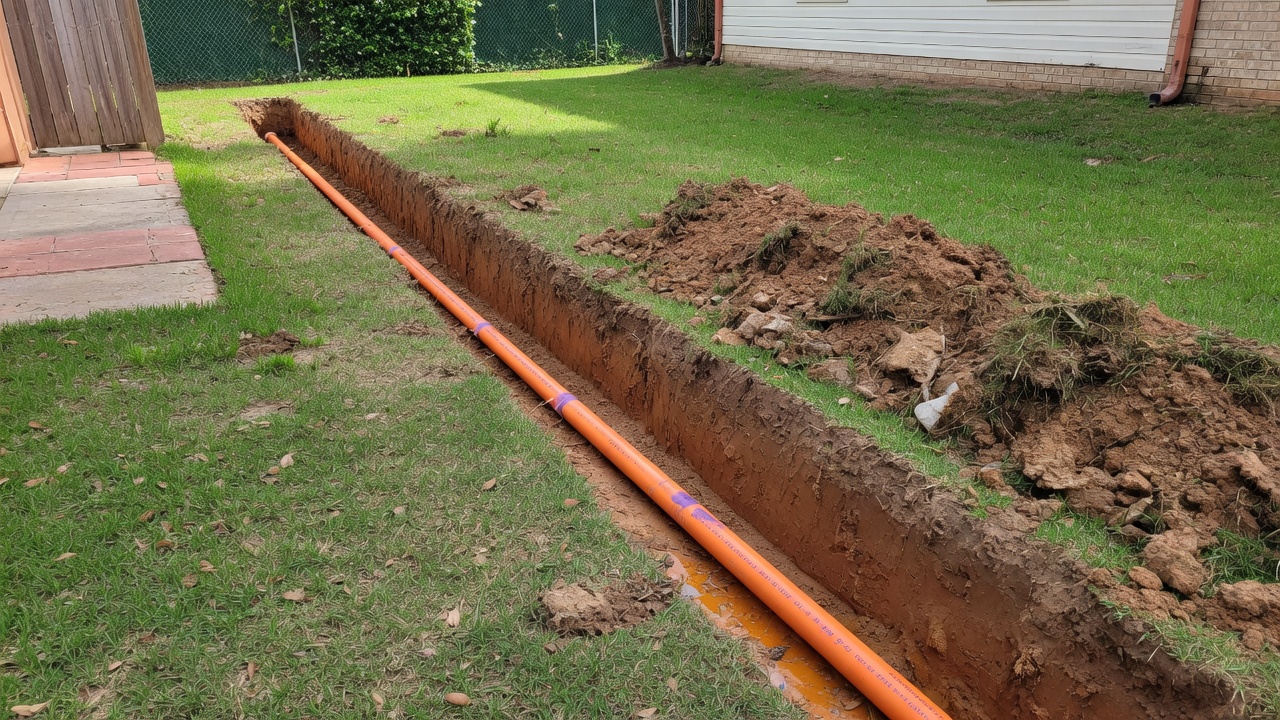
- Valve manifolds and lateral trenching: Using a trencher or pipe-puller depending on site — pipe pulling is lower-impact on established turf and we use it whenever soil and trees allow.
- Heads, swing joints, and flushing: We set heads, install swing joints, then flush every lateral before capping the last head so no construction debris ends up in a nozzle.
- Controller, sensor, Wi-Fi, and walk-through: We wire the controller, connect the rain/freeze sensor, link to Wi-Fi, program the starter schedule, and walk you through operation.
- Inspection and final sign-off: Permit inspection is scheduled with the authority, and you get the as-built drawing and warranty documents.
Thinking About a New System?
Let's walk the property together. We'll sketch the zone layout, test your pressure, and put a fully itemized written quote in your hands before any work begins.
(832) 786-4444Schedule 40 PVC and Why We Don't Cut Corners
A significant chunk of my repair business comes from fixing systems that were installed with Class 200 or SDR-21 thin-wall pipe on the mainline to save money. It works for five or six years and then starts giving up at fittings, especially after a hard freeze. Schedule 40 PVC is roughly 40 percent thicker wall, handles freeze-thaw cycles better, and is what TCEQ spec actually calls for on pressurized mainlines. Every new install we do uses Schedule 40 mainline and laterals, glued with PVC primer first and then Oatey Rain-R-Shine cement — not glue-only shortcuts.
We also use brass or polymer quick-couplers at the backflow service point rather than relying on a plastic ball valve to act as the isolation valve. That gives you a hard shutoff that lasts decades and a quick-connect for future service hoses.
Permits, Backflow, and Houston Water
Installing a new sprinkler system in the City of Houston or most surrounding jurisdictions requires a TCEQ-licensed irrigator, a permit, and a cross-connection (backflow) assembly registered with Houston Water. The backflow then has to be tested annually by a licensed backflow assembly tester — that's our backflow testing service and we handle that year over year after installation so your assembly stays in compliance and you never get a shutoff notice from the water utility.
Some subdivisions, especially newer MUD districts in Katy, Cypress, and the Woodlands, require specific controller features (smart Wi-Fi, rain sensor) in the permit stipulations. We know the common jurisdictions and build to the highest of the applicable specs by default.
System Sizes and Timeline Expectations
A standard Houston quarter-acre residential lot typically comes out to 5 to 8 zones, 1 to 2 drip zones for beds, and takes two to three days of on-site work. A half-acre lot with extensive beds and a rear yard usually lands at 10 to 14 zones and takes three to five days. Larger custom-home properties or commercial installs scale up from there. We keep the property usable throughout — trenches are cut and backfilled in sections, not all opened at once.
From the day you sign the proposal, typical scheduling for a new residential install is two to four weeks, depending on season. Spring and fall book out fastest.
Warranty and Long-Term Support
New installs come with a written warranty covering labor for one year and parts per the manufacturer's warranty, which on Rain Bird, Hunter, and Rachio residential hardware is typically two to five years depending on the component. We're a local Houston company, not a franchise reselling a brand — the same owner and techs who installed your system are the ones who come out for warranty issues.
We also offer an annual spring startup inspection service (see our seasonal startup service) that pairs with the annual backflow test, so your system gets two professional check-ins per year without you having to chase anything down.
Pricing and How We Quote
Every install gets a fully itemized written quote before any work begins. Final pricing depends on lot size, total zone count, head count, head type (rotors vs sprays vs MP rotators vs drip), controller choice, whether we're pulling pipe or trenching, soil conditions, and any drive-under or sidewalk crossings. We also account for Houston-specific site conditions — such as tree-root fields, heavy clay, and existing hardscape — up front rather than tacking them on later.
Call us to schedule a free on-site design visit. That visit gets you a firm written number, a zone map, and a full list of the brands and parts that will go into the system.
Frequently Asked Questions
How many zones do I really need?
Houston zone count is driven by your meter's flow rate and the precipitation type, not just square footage. A typical residential meter delivers enough flow for one rotor zone or one-and-a-half spray zones at a time, so a quarter-acre property with mixed turf and beds usually comes out to 6 to 8 zones. We'll size it properly during the design visit.
Can I add onto an existing system instead of starting over?
Sometimes yes, sometimes no. If the existing system was built with Schedule 40, has a good backflow, and is hydraulically sized with headroom, we can absolutely extend it. If it's Class 200 pipe, undersized mainline, or the backflow is at the end of its life, a full replacement is often cheaper than trying to patch.
Do I need to water by hand until the system is installed?
Typically yes if it's summer. We don't leave the yard without a working system, but during the install week itself you'll want to hand-water key trees and new plantings if conditions are dry.
What about my new sod or new plantings?
We can prioritize those zones in the build sequence so they're the first to come online, and we set a higher watering frequency for the first two weeks to get roots established. Smart controllers let you run a "sod mode" for a defined period and then automatically step down.
Will the install tear up my lawn?
Trenching leaves visible lines for the first few weeks, but with our pipe-pulling setup and careful backfill the turf usually recovers within a growing season. We walk the yard with you beforehand so you know exactly what's being disturbed where.
Can you integrate with my smart home?
Yes. Rachio integrates with Alexa, Google Home, and Apple HomeKit. Hunter Hydrawise has its own app and integrates with most smart home platforms. We set up the account in your name and walk you through the phone app before we leave.