I diagnose more irrigation problems from a water bill conversation than from anything else. Your bill contains numbers that tell a clear story — if you know how to read them. Here's what to look for and what the numbers mean.
Understanding Houston Water Bill Units
Houston Water bills usage in CCF — hundred cubic feet. One CCF equals 748 gallons. Your bill shows current month usage, last month, and same month last year. The comparison to last year is the most useful data point for diagnosing an irrigation problem.
A typical Houston household of 3–4 people uses roughly 8–12 CCF per month for indoor use (toilets, showers, laundry, cooking) regardless of season. Outdoor irrigation use on top of that varies significantly — from near zero in cool wet months to 15–25 CCF or more during a hot dry summer.
What "Normal" Irrigation Use Looks Like
A 2,500 square foot lawn with a properly adjusted system running on a once-a-week Stage 2 schedule during Houston summer uses approximately 8–12 CCF per month for irrigation alone, depending on grass type and zone run times. Combined with indoor use, a total bill of 18–22 CCF per month in July/August is reasonable for a mid-sized Houston home with a well-maintained system.
If you're seeing 35–50 CCF in a summer month, you have one of three things happening: the system is running too long or too often, there's a leak somewhere underground, or a zone valve is stuck open and running outside the scheduled times.
How to Use the Leak Indicator
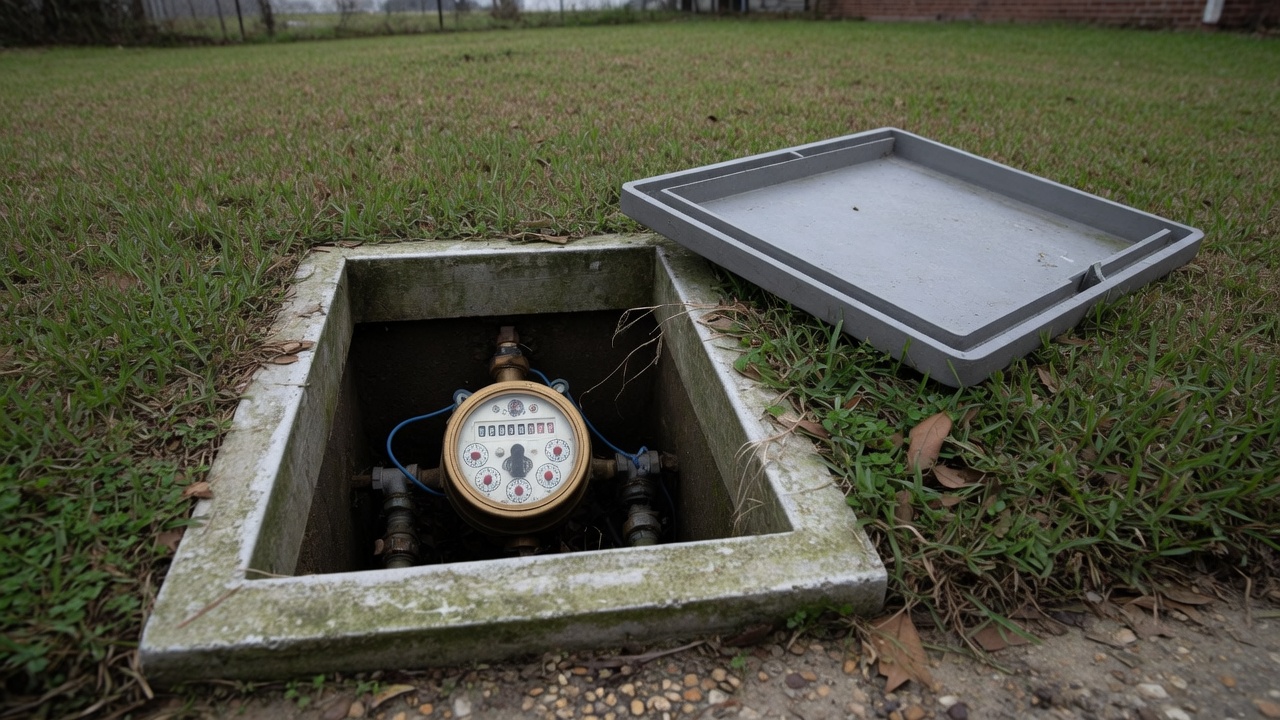
Houston water meters have a small triangle or star-shaped leak indicator on the face of the meter. When water is flowing through the meter — even a small amount — this indicator rotates. Here's how to use it:
- Turn off all water inside the house: faucets, dishwasher, ice maker, everything
- Make sure your irrigation controller is off and not mid-cycle
- Go to the meter box at the street and watch the leak indicator for 2–3 minutes
- If it's moving, water is flowing somewhere
A slowly moving indicator (completing a revolution every few minutes) suggests a small leak — could be an irrigation line with a pinhole, a toilet flapper that's seeping, or a valve that isn't closing completely. A rapidly moving indicator suggests a larger break — a lateral line failure, a head that sheared off at grade, or a supply line rupture.
Separating an Irrigation Leak from Overwatering
This matters because the fix is different. If your bill is high because you're running the system too often, the answer is adjusting the schedule. If it's high because there's a leak, you could cut the schedule in half and still have the problem — the water is going somewhere regardless of the schedule.
The easiest test: check the meter with the system off and it hasn't run for several hours. No movement means no continuous leak — any high usage is schedule-related. Movement on the meter with everything off means there's a leak somewhere.
For irrigation-specific leaks, you can isolate further: turn off the irrigation supply ball valve and check the meter again. If the indicator stops moving when the irrigation supply is off, the leak is in the irrigation system. If it keeps moving, the leak is in the domestic supply (house plumbing).
Year-Over-Year Comparison: The Most Useful Number
Your bill shows same month last year. Compare July this year to July last year. If this July is 8 CCF higher than last July, and your watering schedule hasn't changed, that 8 CCF delta (about 6,000 gallons) is almost certainly a leak that developed sometime in the past year.
A slow underground leak — a pinhole in a lateral line, a fitting that's cracked slightly from clay soil movement — might not be visible on the surface. The grass above it may look great, actually. But the meter sees it.
If you notice a consistent year-over-year increase in summer usage without a change in your lawn size or schedule, call us for a leak detection check. We pressure-test zones and use soil probes to find the leak location without excavating the entire yard.
Reading the Sewer Charge
One thing most Houston homeowners don't realize: the sewer portion of your water bill is calculated based on winter water usage, not current water usage, precisely because the city understands that summer irrigation isn't going down the drain. If you moved into a new house or had unusually low winter usage, your sewer base rate will be lower — which actually reduces your summer bill compared to what a higher winter user pays.
This also means that an irrigation leak, while expensive in water usage fees, doesn't compound through the sewer charge the way an indoor leak would. Cold comfort, but worth knowing.
Bill Higher Than It Should Be?
We find irrigation leaks that don't show up on the surface. Pressure testing and zone-by-zone audit on the first visit. Call us and we'll figure out where the water is going.
(832) 786-4444